
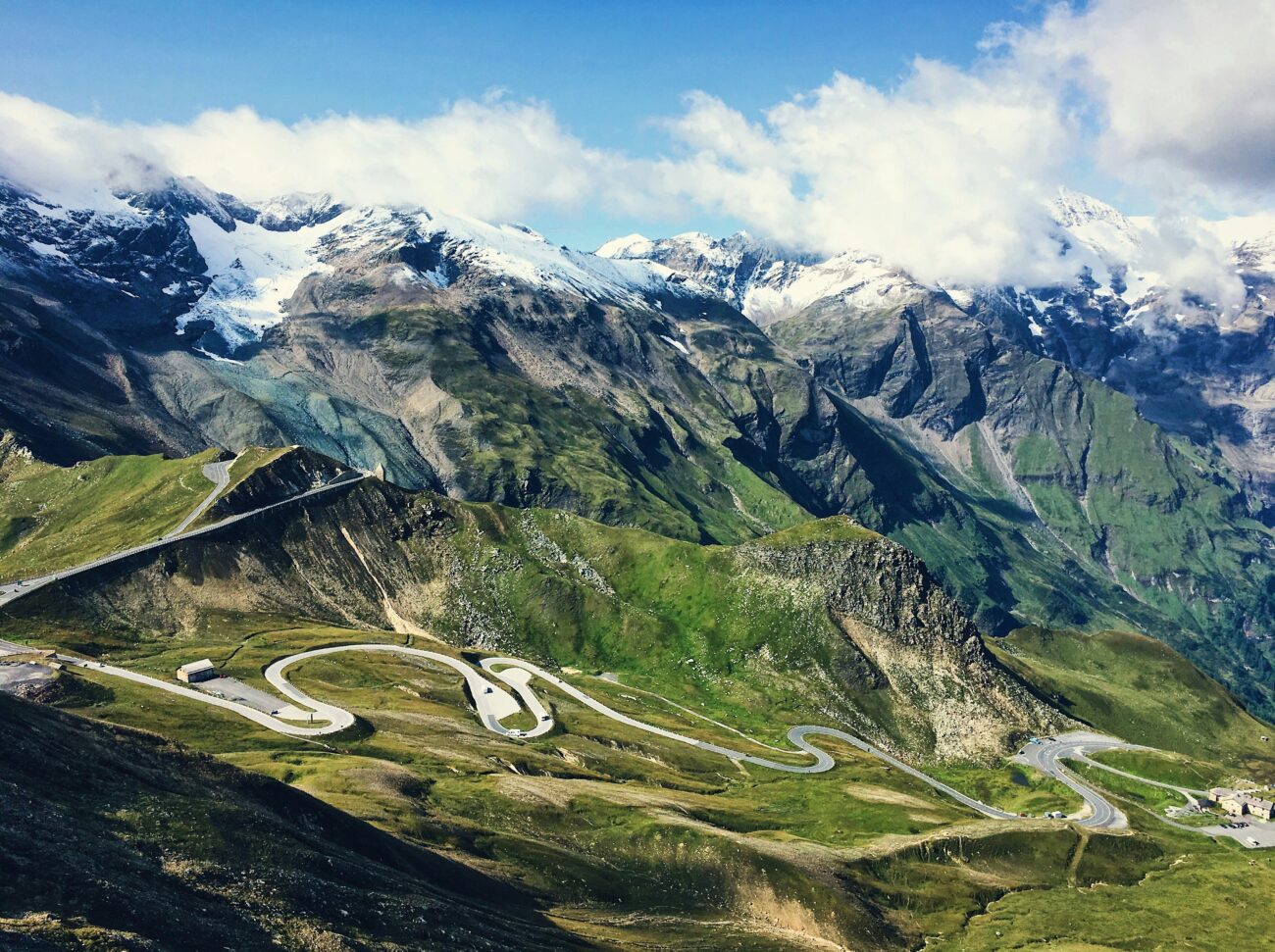
The Grossglockner High Alpine Road has been Austria’s ultimate driving playground since it opened in 1935. Conceived as a work project during the Great Depression, the 48‑kilometre ribbon of tarmac winds from Fusch to Heiligenblut through the Hohe Tauern National Park. It climbs 36 hairpin bends to the 2,504‑metre Hochtor pass and remains the highest paved pass in the country. Open from early May to early November, the road pairs smooth, sweeping curves with long sight‑lines that make it irresistible for classic cars and modern supercars. The surrounding glaciers and jagged peaks feed the soul.
Engineering that flows with the mountains
Engineer Franz Wallack designed the route to blend with the landscape. It climbs through four vegetation zones – from forested valley to sub‑alpine meadows, barren tundra and snowy summits. The highest drivable spur, Edelweiss‑Spitze, reaches 2,571 m and offers a 360‑degree panorama of more than thirty 3,000‑metre peaks. On a clear day you can see the shimmering Pasterze Glacier hugging the face of Grossglockner. Gradients rarely exceed 12 %, so even older engines stay comfortable while modern exotics can stretch their legs. Just make sure your brakes are up to windy mountain passes.
Built for driving pleasure
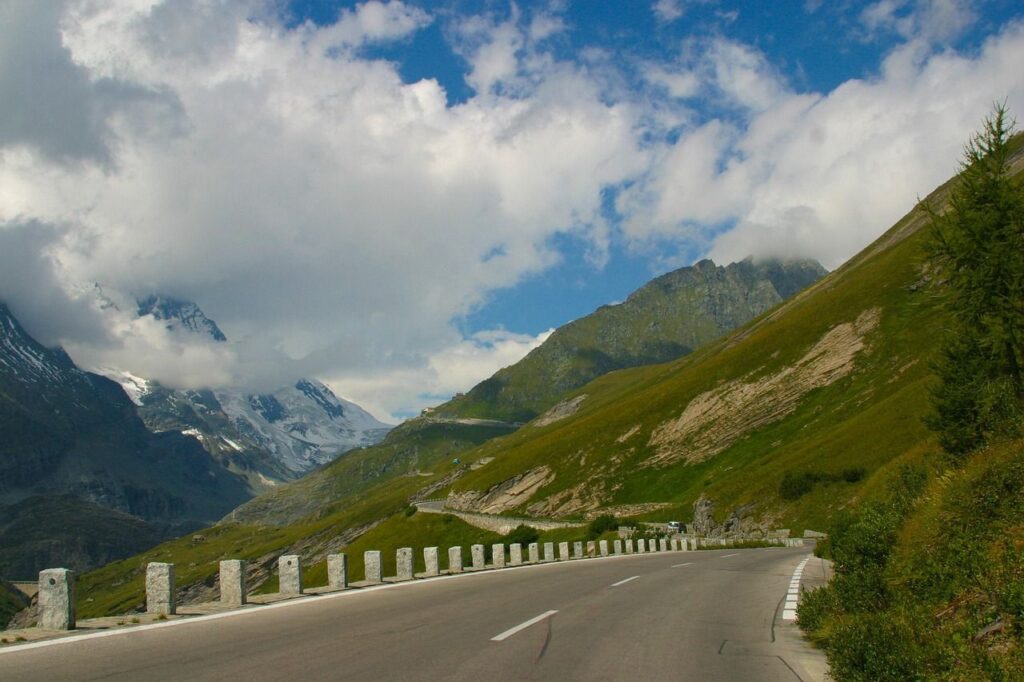
Despite being almost a century old, the Grossglockner feels tailor‑made for spirited driving. Wide, cambered corners and long straights make it an “Oldie drive” – a route praised for its mellow twists and gentle inclines. At Kaiser‑Franz‑Josefs‑Höhe (more info here) a small car exhibition celebrates the first cars that conquered the pass in 1934. Today the same features – silky tarmac, fast sweepers and jaw‑dropping scenery – make the road a playground for modern sports cars.
Highlights worth stopping for
A Grossglockner High Alpine Road road trip isn’t about bombing from start to finish; it’s about savouring the mountains. Don’t miss Edelweiss‑Spitze: a spur road climbs to the highest viewpoint accessible by car, where you can gaze over the serpentine road you’ve just driven. At the far end of the pass, Kaiser‑Franz‑Josefs‑Höhe hosts the car museum and platforms overlooking the eight‑kilometre‑long Pasterze Glacier. Between these bookends lies Fuscher Törl (2,428 m) with its terrace and the Hochtor summit tunnel that recalls Celtic and Roman traders. If time allows, detour to the Glocknerhaus for lunch and a look at the turquoise Margaritzenstausee or stroll to the waterfall‑fed Nassfeldspeicher reservoir
Practical tips for drivers
The pass is normally open from early May to early November. Peak tourist season (July and August) brings buses and campervans, so aim for mid‑May to mid‑June or September to find quieter roads. Toll booths open around 5:30 a.m.; a day ticket costs about €37 per car and includes access to exhibitions and trails. For a magical dawn run, stay inside the toll gates at Mountain Hotel Wallackhaus or the simple Edelweißhütte; you’ll have the road to yourself as the sun lights up the peaks.
Classic cars and exotics alike should be well prepared. Check brakes, tyres and fluids; carry extra coolant and oil, and remember alpine weather can change quickly. Fill your tank before entering – there are fuel stations in Fusch and Heiligenblut. On the road, use lower gears on descents, pull over for faster traffic and watch for cyclists. The Grossglockner is a public road, not a racetrack; enjoy its rhythm rather than attacking every corner.
Community and camaraderie
One of the joys of driving the Grossglockner is sharing it. Annual events, from old‑timer tractor meets to Vespa gatherings, attract enthusiasts from across Europe. Even on a regular day you’ll meet fellow travellers at viewpoints, swap stories over coffee and undoubtedly leave with ideas for your next European road trip.
Getting there
The Grossglockner is an amazing place, but it isn’t remotely near to any of the arrival points us road trippers generally use to get to the Continent. It’s a 13 hour drive to get there in total as this road is well into Europe. It is actually quite close to Slovenia, to give you an idea of the geography.
Therefore, my suggestion would be to break up the journey, take a few days to do it and enjoy the scenery as France gives way to Germany, and then to Austria. Assuming you enter France via Calais, good stopping points would be Verdun (France, 4 hours), Stuttgart (another 4 hours, for its motoring history) and then on to the pass itself (5.5 hours drive).
The verdict
A Grossglockner High Alpine Road road trip delivers more than a stunning drive. It’s a living monument to human ingenuity – a road built to lift a nation out of economic despair that now delights motorists from around the world. Its design suits everything from 1950s roadsters to modern hypercars, and the combination of engineering, landscape and culture makes it unforgettable. The next time you long for a road that truly celebrates driving, point your car toward the Austrian Alps. The Grossglockner will remind you why you fell in love with the open road.
I hope this article has been useful in your road trip planning and helps you to have the confidence to get out there and enjoy the open road and a beautiful vehicle. If you like what you read here, be sure to check out our bi-weekly newsletter, the Touring Standard, and our Ultimate Road Trip Guide. Finally, check us out on Instagram if you haven’t already!
